July 2026
NINOS Education & Development has completed and submitted the End Program Evaluation (EPE) for the Kubu Raya Area Program — an eleven-year child protection program across six villages in Sungai Ambawang Sub-district, Kubu Raya District, West Kalimantan, implemented by Wahana Visi Indonesia (World Vision Indonesia).
The report has been received and approved by WVI in both Bahasa Indonesia and English. This evaluation marks one of the most comprehensive assignments NINOS has undertaken, and we want to share why this work matters, how we carried it out, and what we learned.
About the Programme Evaluated
The Kubu Raya Area Program (AP) is a community-based child welfare program that ran from 2013 to 2025 across six villages in rural West Kalimantan, with a total budget of over USD 5.4 million. The program addressed real challenges: high rates of violence against children, limited access to protection services, and deeply rooted socio-cultural norms including child marriage and physical discipline.
Across three implementation phases, the program built community-based child protection systems, empowered adolescents through Child Forums and life skills training, integrated positive parenting modules through faith leaders, and contributed to more than 65 pro-child policy instruments across four levels of government.
About the Programme Evaluated
The Kubu Raya AP was designed to address real challenges in target communities: social norms normalising child marriage, household-level violence, weak community-based child protection mechanisms, and limited access to quality services. The programme ran across three phases (2013–2025) with a total budget of over USD 5.4 million, covering six villages with approximately 28,651 residents.
Across these three phases, the program built community-based child protection systems (PATBM/CBICP), empowered adolescents through Child Forums (Forum Anak) and life skills training, integrated positive parenting through faith leaders, and contributed to more than 65 pro-child policy instruments across four levels of government.
Evaluation Purpose and Framework
This EPE was designed to systematically assess programme performance and results using the six OECD-DAC evaluation criteria: relevance, effectiveness, efficiency, impact, sustainability, and advocacy.
Specifically, the evaluation aimed to:
- Assess the extent to which the programme achieved its intended objectives and outcomes at the levels of children, households, communities, and systems
- Identify enabling and constraining factors affecting the achievement of results
- Assess programme sustainability: including the readiness and capacity of communities and local systems to continue effective practices beyond WVI’s direct support
- Generate actionable recommendations for transition planning, strengthening local partnerships, and future programme design
This evaluation placed particular emphasis on the principles of child participation, gender equality, and social inclusion as integrated dimensions of programme implementation.
Methodology: A Rigorous Mixed-Methods Approach
NINOS served as the independent evaluation team, working alongside WVI’s national PEARL team. Our methodology included:
Primary quantitative data: Caregiver/Guardian Survey (CGS, n=240) and Youth Healthy Behaviour Survey (YHBS, n=243), using Probability Proportional to Size (PPS) two-stage cluster sampling. Data were disaggregated by sex, age group, village, sponsorship status, and disability.
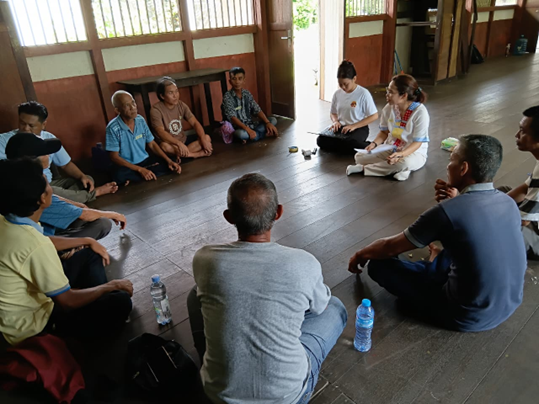
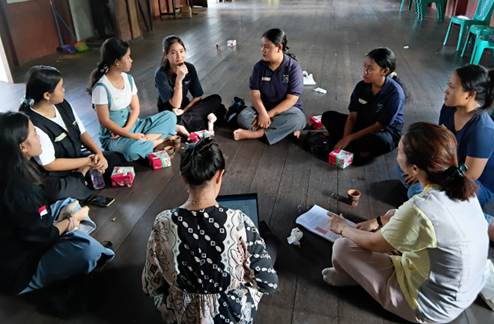
Qualitative data : 10 Focus Group Discussions and 11 Key Informant Interviews across six villages, involving children, adolescents, caregivers, PATBM cadres, faith leaders, traditional leaders, government officials, and implementing partner YGPB.
Most Significant Change (MSC): Four MSC narratives capturing the deepest changes from a community perspective, combined with PRA tools (community mapping and the Ten Seed Technique).
Partner capacity assessment: Analysis of four annual cycles of the Comprehensive Organisational Capacity Assessment (COCA) for implementing partner YGPB.
Document review: Annual reports FY2014–FY2025, PATBM case management logbooks, CMS data, local policies, and PQSR documents.
Key Findings
The programme achieved significant and measurable reductions on both goal-level child protection indicators — both statistically significant and meeting the end-of-programme targets.
Most meaningfully, change has become embedded in institutions that will remain after the programme ends: Child Forums in all six villages now hold formal legal recognition and operational village budget allocations. PATBM built a case response pathway where none had existed before — achieving 100% case follow-up in the final two years, a performance reached by only four APs nationally. Implementing partner YGPB progressed from the Emerging category (49.8%) to Maturing (80.6%) across four independent assessment cycles.
On the advocacy side, the programme contributed to more than 65 pro-child policy instruments reaching hundreds of thousands of children in Kubu Raya District. The evaluation also notes areas requiring strengthening: gains on several indicators tended to decline when programme activities decreased in intensity; a number of enacted regulations had not yet been fully implemented on the ground, largely due to regional budget and village fund efficiencies; and communities within oil palm plantation areas were not effectively reached by the programme.
The NINOS Evaluation Team
NINOS is a programme evaluation and community development consultancy specialising in education, health, child protection, adolescent empowerment, and local systems strengthening. We believe good evaluation is not only about measuring what happened — but helping clients understand why something worked, apa remains fragile, and where to go next.
Interested in Working Together?
If your organisation is planning a programme evaluation, partner capacity assessment, or impact study particularly in child protection, community empowerment, or faith-based programming — we welcome the conversation.
📧 ninosindonesiafoundation@gmail.com | 🌐 ninosfoundation.org | 📍 Duren Sawit, Jakarta, Indonesia


 English
 Italian
 German
 Spanish
 Chinese (Simplified)
 Arabic
 Indonesian