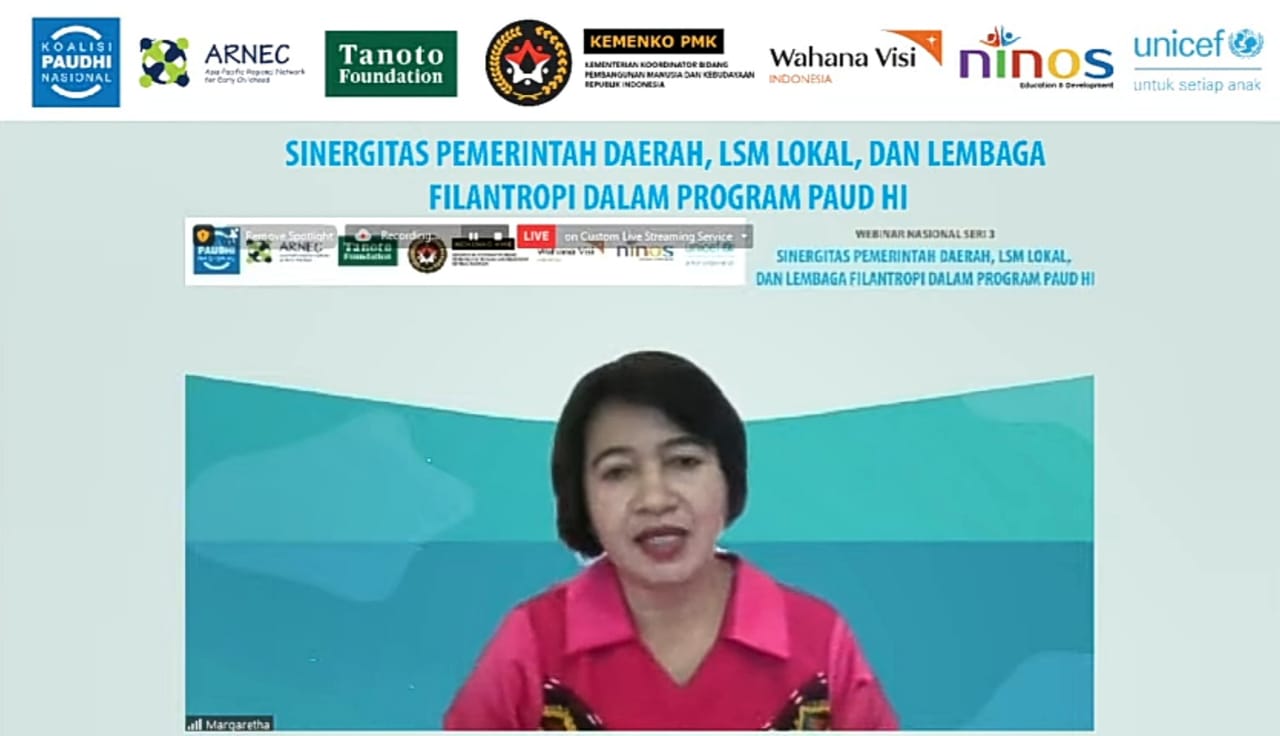
Teamwork makes the dream work. Such a phrase highlighted the encore of the webinar series, which was held on March 16th, 2022. Unlike the two previous webinars, UNICEF and World Vision Indonesia also took part in managing, along with the Coordinating Ministry of Human Development and the Culture Republic of Indonesia, the National Coalition of Holistic-Integrative Early Childhood Development (HI-ECD), ARNEC, Tanoto Foundation, and NINOS Education. This series still raised the topic of collaboration to create actions in improving HI-ECD and prevent stunting, with a special twist of involving civil society organizations, such as Sumba Integrated Development (SID) and philanthropic foundations, namely William & Lily Foundation (WLF), and Tanoto Foundation to talk about HI-ECD program implementation in their assisted areas.

This final webinar felt a little bit more intimate with over 180 attendees. As the session was conducted online, the participants are welcome to leave questions at any time. Due to the smaller number of participants, our speakers were able to answer all of the questions both using live answer and chat feature, which made this webinar went even more interactive as the discussions are kept lively. Further, this webinar also brought in two responder coming from the Education Cluster of Indonesian Philanthropy and the Coordinating Ministry of Human Development and the Culture Republic of Indonesia.
Participants were first introduced to a successful collaboration of Southwest Sumba government, Pogo Tena Village government, and CSO (SID, WLF, and Adaro Foundation). This cooperation resulted in the initiation of the first HI-ECD task force led by Margaretha Tatik Wuryaningsiih Mete. Amidst the challenges that the team faced, such as the lack of awareness on HI-ECD, political turbulences in the village government, and funding in the sub-district level, this task force still managed to perform major significance in Southwest Sumba. The programs handled by the task force focused on training for advocacy, responsive parenting, and educational curriculum. The district government’s support for this task force was shown at the publication of a circular letter regarding the allocation of village funds for HI-ECD and the passing of Regent’s Regulation on HI-ECD. One important key message taken from this panel was the importance of using a local and cultural approach in implementing the programs as well as collaborating with the local public, ethnic, female, and religious figures.

As for the philanthropic foundation, investing in HI-ECD became the focus that these foundations could make the most impact from. The Education Cluster of Indonesian Philanthropy survey showed that the involvement of such foundations influenced the most on developing teachers’ and health volunteers’ capabilities. Furthermore, the panelists also underlined the importance of synergy in creating improvements regardless of the stakeholders’ varying responsibilities. Accurate data and research will also be helpful when mapping out the programs that need philanthropic assistance.

Last but not least, Syifa Andina from ARNEC Indonesia summarized all three sessions of the webinar by showing how holistic and integrated teamwork is the only key to an accomplished HI-ECD. At the family level, both fathers and mothers should have a balance contribution in raising their children. At the village level, coordination of the headmen, cadres, ECD teachers, and field officers is crucial in maintaining quality services. At the district, provincial, and national levels, legal basis, data-driven policies, and budget alignments are the essential tools to carry out such programs. Stream the webinar at https://youtu.be/-yXuK4ChSd8. You can also read the materials at .


 English
 Italian
 German
 Spanish
 Chinese (Simplified)
 Arabic
 Indonesian